
Master data cleansing
Master data cleansing: turn a dirty database into a reliable asset.
Master data cleansing, also called data cleansing, data cleaning or data scrubbing, is the process of cleaning, standardizing, deduplicating, validating and enriching a company's material, customer and supplier records until each one becomes a golden record. 4MDG does it with AI, more than 600 public sources and native SAP integration, and puts in place the governance that keeps bad data from coming back.
In just a few days you see the duplicates, inconsistencies and risks hidden in your database. No commitment required.
Trusted by 160 clients











Integrations
What we cleanse
Three cleansing fronts, with individuals and legal entities in the first two.
Customer data cleansing
Individuals and legal entities
Identity validated against public registry databases, registration status normalized, address and postal code standardized, verified contacts and duplicates merged into a golden record. A database ready for billing without rejections.
Customer data cleansing →Supplier data cleansing
Individuals and legal entities
Business registration status, ownership structure, tax regime, certificates, sanctions lists and verified bank details. Duplicate suppliers unified and irregular records flagged before payment.
Supplier data cleansing →Cleansing of materials, products and services
The entire catalog, item by item
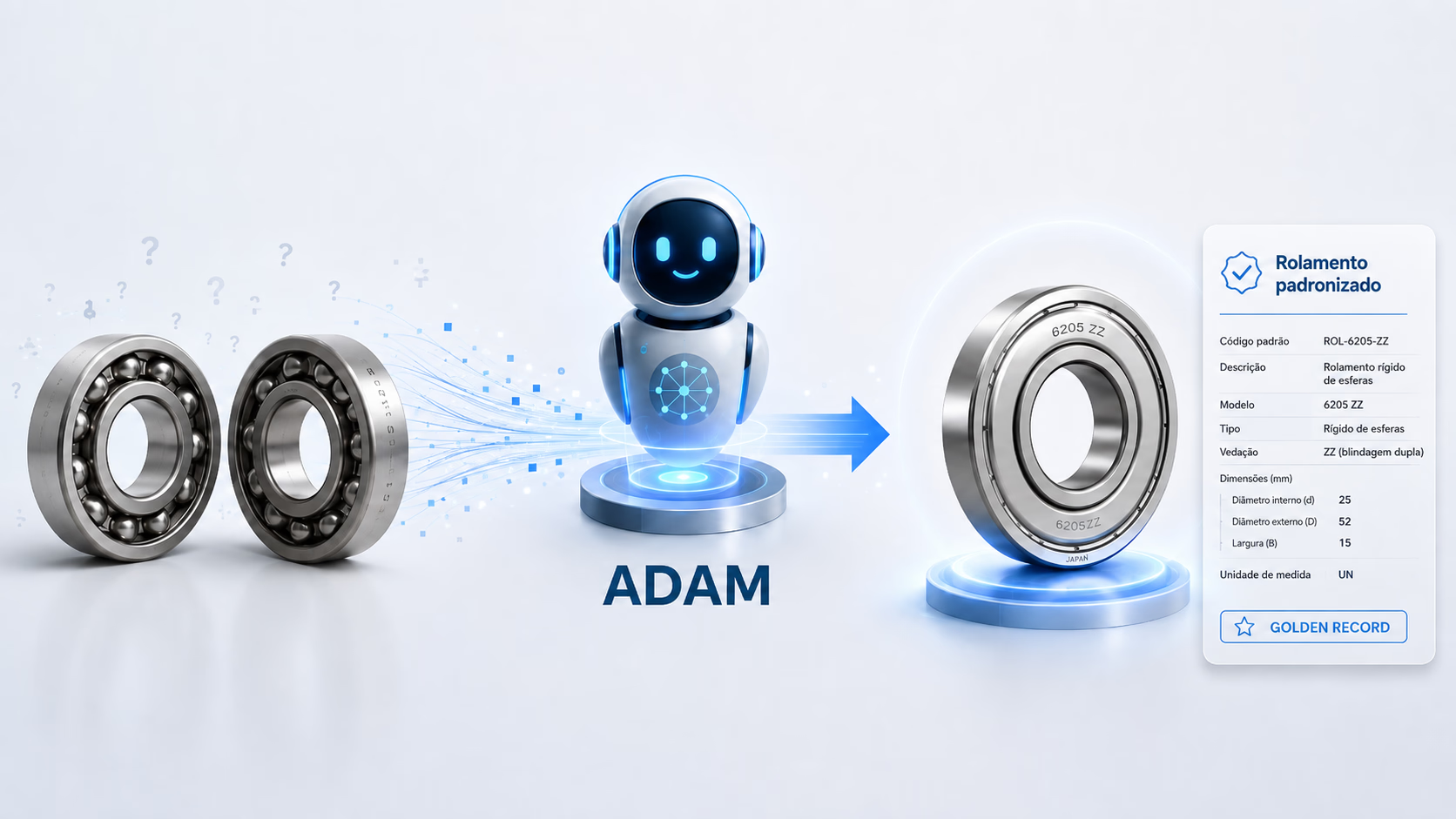
Rule-based standardized descriptions, attributes by family, unit of measure, packaging, product classification codes and UNSPSC, translation and deduplication. Covers materials, MRO, resale products and service catalogs.
Material data cleansing →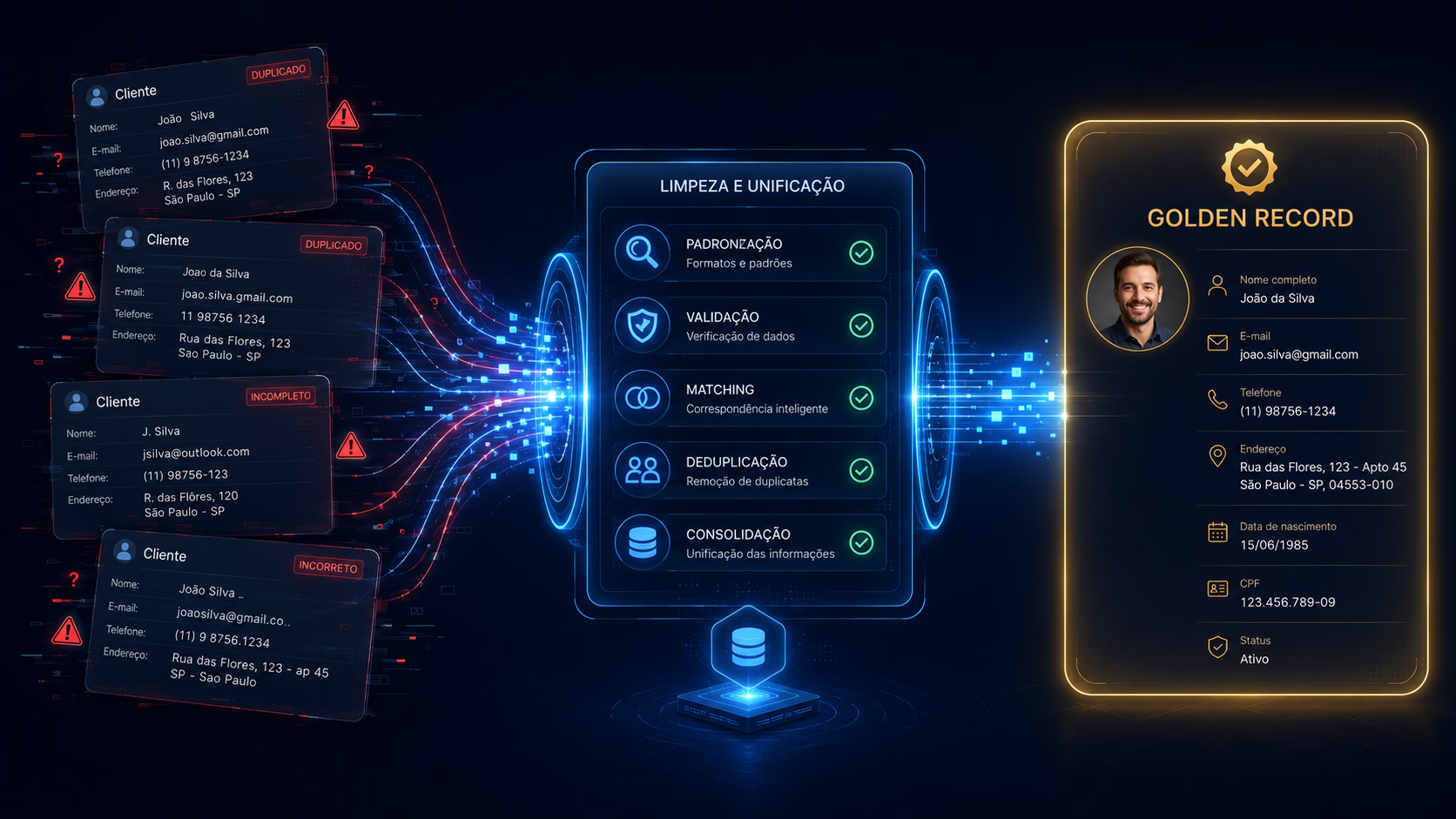
You can start with a single domain: the diagnostic shows which one delivers the most return.
The invisible cost
Your dirty data is already costing you: it just isn't on the invoice.
The same customer registered three times. A supplier with no validated registration. "Screw", "scr." and "SCREW M6" as different items.
The result shows up as duplicate purchases, wrong payments, stockouts, tax fines and reports nobody trusts.
US$ 12,9M
is the average annual cost of poor-quality data per company. Gartner.
up to 25%
of annual revenue is what incorrect data can consume. 4MDG reference.
Bad data stalls ERP, CRM, BI and, now, AI
A model trained on dirty data doesn't make fewer mistakes: it fails at scale, with the appearance of certainty.
A diagnostic on a sample of your database, with nothing to install.
Concept
What is master data cleansing?
Master data cleansing, also called data cleansing, data cleaning or data scrubbing, is the set of techniques that corrects and organizes a master database: it removes duplicates, standardizes descriptions and formats, fills in missing fields, validates information against official sources and eliminates invalid records.
The goal is the golden record: a single reliable version of each material, supplier and customer, published to every system that consumes that data.
Data cleansing, data cleaning, data scrubbing and data quality: different names for the same work. Data quality is the measured result; master data cleansing is the project that delivers it, including deduplication; and material master data cleansing is the same work applied to the material catalog.
Terminology
Scrubbing, deduplication and enrichment: what's the difference?
Scrubbing
Corrects and standardizes what is wrong or off-standard: formats, descriptions, units, required fields left blank.
Deduplication
Identifies and merges repeated records into a single golden record, with similarity scores and survivorship rules.
Enrichment
Completes and updates records with data from reliable sources: tax status, CNAE, address, certificates, technical attributes.
At 4MDG, all three happen together and continuously, not as a one-off cleanup that is lost the following month.
Scrubbing, deduplication and enrichment in the same flow.
PDM and PDS
There is no clean database without standard descriptions.
PDM and PDS are the descriptive standardization disciplines that make cleansing last. Deduplicating without standardizing treats the symptom: next month the same item returns under another name.
PDM
Descriptive standardization of materials
Describing each item in a unique, structured way: taxonomy by family, attribute templates, short and long descriptions generated by rule, unit of measure, packaging and tax classification. It's what makes items findable in search, prices comparable and duplicates visible before they are created.
See the PDM page →PDS
Descriptive standardization of services
The same discipline applied to the service catalog: clear scope, unit of measure, measurement criteria and tax linkage. Without it, "preventive maintenance" becomes thirty records, each with its own price and terms.
See the PDS page →Standardize before deduplicating
With structured attributes, matching compares apples to apples: similarity scores become far more precise.
A standard that protects the database
Rule-generated descriptions keep the next requester from creating the same item with different free text.
Services dirty the database too
Contracting services without scope or unit of measure creates duplicates and disputed measurements, just like materials.
The diagnostic measures how many items are missing attributes, off-standard or duplicated.
In SAP
Master data cleansing in SAP.
Material master (SAP MM)
In SAP, material records live in the material master, and each item reaches it with a standardized description, attributes and classification.
Business partner (BP)
In SAP S/4HANA, customers and suppliers live in the business partner, and cleansing validates Brazilian tax IDs (CPF and CNPJ) and merges duplicates before the load.
Loads by IDoc, BAPI and file
The cleansed data enters SAP ECC or S/4HANA by API, IDoc, BAPI or file, day to day and in projects.
Rollout and S/4HANA migration
In a rollout or migration, standardization happens before the load: the new system starts clean.
Governance after go-live
Rules at entry and an approval workflow keep master data clean after the load.
How to do it
How to do master data cleansing in five steps.
STEP 01
Diagnostic
We measure the state of the database: duplicates, inconsistencies, empty critical fields, invalid records and hidden tax risks.
STEP 02
Standardization
We apply taxonomy and rules: short and long descriptions, formats, units, classifications and naming by family.
STEP 03
Deduplication
We identify and merge repeated records into a golden record, with similarity scores and attribute-by-attribute survivorship.
STEP 04
Validation and enrichment
We verify and complete records against more than 600 public sources, with AI support: registration status, CNAE, address, certificates and technical attributes.
STEP 05
Continuous governance
We install entry rules, approval workflow and indicators so bad data doesn't come back the following month.
The fifth step is what sets 4MDG apart from a common cleanup.
Your data is not clean just once: it stays clean.
The fifth step is what keeps the database clean after the project.

Why 4MDG
Different from a common cleanup.
Cleansing and governance together
We solve the cause, not just the symptom. Entry rules and workflow keep the problem from coming back.
AI and more than 600 public sources
Validation and enrichment at scale, checked at the source with evidence stored per record.
All three domains
Materials, suppliers and customers, not just marketing mailing lists.
Native SAP integration
The treated database enters the ERP clean, via API, IDoc, BAPI or file.
Software and people (DaaS)
We can run your cleansing continuously for you, under an agreed SLA.
ISO/IEC 27001 and LGPD
Your data handled under a certified management system, in compliance with LGPD and GDPR.
Proof
Clean data, measurable results.
−87%
Wella Company · supplier SLA, with −78% for customers and −84% for materials, and 100% of records managed by 4MDG.
+174k
Industry (SAP) · records standardized and cleansed, with optimized e-procurement and fewer purchases from wrong descriptions.
60M
records under management, for 160 clients in 6 countries.
Wella Company cleansed its master data and now runs 100% of its records with 4MDG, with an SLA 87% shorter for suppliers, 78% for customers and 84% for materials.
A manufacturer running SAP cleansed and standardized more than 174,000 records, with optimized e-procurement and fewer purchases made from wrong descriptions.
Cristália · indirect materials cleansing: a clean, standardized MRO and consumables database, with operational improvement and cost reduction.
Get these results on my databaseHow to choose
How to choose a master data cleansing company.
Documented PDM methodology
Ask for the descriptive standard in writing: taxonomy, attributes by family and the rule for short and long descriptions.
Deduplication with scoring and survivorship
Merging must show the similarity score and the rule that decides which value survives in the golden record.
Validation against official sources
Tax IDs, state registration and registration status checked at the source, with evidence kept for each record.
ERP integration without spreadsheets
The cleansed data must enter your ERP by API, IDoc, BAPI or file, with no manual spreadsheet rework.
Governance after the project
Without rules at entry and an approval workflow, the data gets dirty again within a few months.
Certified security: ISO 27001 and LGPD
Your master data should be handled under an ISO/IEC 27001 certified management system and in compliance with Brazil's LGPD.
Cases in your industry
Ask for measured results at companies like yours, with numbers and the client's name.
A team that runs your master data
If you want to outsource, the same company should be able to run data cleansing continuously, under an SLA.
What you gain
What changes when your data becomes reliable.
Fewer duplicate purchases
Unique, findable items cut repeat purchases and idle inventory.
A month-end close that adds up
Spend by category, ABC curve and supplier views stop diverging between areas.
Faster onboarding and qualification
Records done right the first time shorten the path to the first purchase or sale.
Less tax and compliance risk
Registration status, certificates and tax classification checked at the source and revalidated.
Data ready for BI
Reports built on a single database stop being a debate over which number is right.
Data ready for AI
AI models and agents only deliver value on reliable, traceable master data.
BI and AI only deliver value on reliable master data.
Investment
How much does master data cleansing cost.
The price depends on the size and depth of the work, not on a fixed price list. Five factors define the investment.
That is why the first step is to measure: the free assessment counts the records, duplicates and critical fields in your data before any quote.
Volume and domain
How many records, and which ones: materials, customers or suppliers.
Depth
Deduplication only, or full descriptive standardization with NCM and UNSPSC.
Sources and format
Which external sources are checked, and whether it is a one-off project or monthly Data as a Service.
The assessment measures volume before quoting, with nothing to install.
Contact
Let's look at your database before proposing anything.
A specialist analyzes your scenario and shows the current state of records in your industry. No commitment required.
Av. Queiroz Filho, 1700, Torre E, Conjuntos 715 a 718
Vila Leopoldina, São Paulo, SP, 05319-000
FAQ
Questions about master data cleansing
It is the process of cleaning, standardizing, deduplicating, validating and enriching a master database to make it unique, accurate and reliable, down to the golden record of each material, supplier and customer. It is also called data cleansing, data cleaning or data scrubbing.
They are nearly synonyms. Cleansing usually covers the full process, including deduplication and enrichment; scrubbing emphasizes correcting and standardizing whatever is off-standard.
In five steps: a diagnostic of the current state, standardization with taxonomy and rules, deduplication into golden records, validation and enrichment against official sources and, finally, continuous governance so bad data doesn't come back.
It depends on the volume and state of the database. 4MDG's free diagnostic shows the real size of the job within days, with the number of duplicates and incomplete or irregular records.
Yes, all three master data domains, plus services and reference data. The model, rules and data sources change by domain.
With rules at entry, an approval workflow and tracked data quality indicators, or with 4MDG Data as a Service, which runs data cleansing and record maintenance continuously under an agreed SLA.
Yes, natively. The treated database enters SAP ECC or S/4HANA and other systems clean, via API, IDoc, BAPI or file, both day to day and in migrations and rollouts.
Yes. ADAM, 4MDG's AI, interprets free-text descriptions, builds the standardized description, suggests classifications such as NCM and UNSPSC and flags similar records, always with human review before publishing.
It depends on five factors: the number of records, the domain (materials, customers or suppliers), the depth of the work (deduplication only or full descriptive standardization with NCM and UNSPSC), the external sources checked and the format, a one-off project or monthly Data as a Service. The free assessment measures your data before any quote.
It depends on the depth. Deduplication and unit normalization are much faster than applying the full descriptive standard, with attributes, NCM and UNSPSC. The free assessment estimates the timeline from a real sample of your catalog.
Yes. Material master data cleansing happens before the load: 4MDG publishes the cleansed records to SAP ECC or S/4HANA by API, IDoc, BAPI or file, day to day, in rollouts or during migration.
They are names for the same work. Master data cleansing, data cleansing, data cleaning and data scrubbing all describe correcting, standardizing, deduplicating and validating records. Scrubbing usually stresses fixing what is out of standard; cleansing covers the whole process.
Data quality is the measured result: completeness, uniqueness, validity and consistency of the data. Master data cleansing is the project that brings the data to that level, and governance is what keeps data quality after the project.
Check eight points: a documented descriptive standardization method, deduplication with scoring and survivorship rules, validation against official sources, ERP integration without spreadsheets, governance after the project, ISO 27001 and LGPD certified security, cases in your industry and a team able to run your master data if you want to outsource.