
Inside the platform: capabilities, architecture and security.
4MDG is a 100% cloud-based SaaS MDM platform, AI-native: an assistant in every module, an MCP server that puts your data governance inside Claude, Cursor or any compatible host, low-code workflow, REST API with OAuth 2.0 and search resolved within the database itself. This page goes into the detail: each block opens in a drill-down from the business summary to the technical specification.
Model Context Protocol
Your data governance inside your AI.
The platform exposes a native Model Context Protocol (MCP) server. Claude, Cursor or any compatible host connects straight to your tenant and, with the permissions of whoever authorized the connection, you ask, register and configure in plain language inside your own AI assistant. For example: "how many suppliers have had a pending record for more than 5 days?".
Native MCP server
The platform exposes a Model Context Protocol server (HTTP streamable). Claude (desktop, web and Claude Code), Cursor or any MCP client connects straight to your tenant.
With that person's permissions, and nothing more
The connection is authorized by the user through OAuth. The AI sees and does exactly what that person can see and do on the platform, respecting roles, departments, stages and row-level access rules.
All six modules, not just queries
The same tools as the internal assistant are available in the host: query and aggregate records, open and fill in registrations, design models, flows and rules, test rules against real samples, manage members and permissions, configure deadlines, compare and promote environments, administer organizations.
Irreversible actions require human confirmation
Publishing a record, promoting an environment, removing access: over MCP the AI prepares the action and returns a link. The person confirms it, inside the platform.
Traceable
Everything that arrives through MCP is logged as done by the person via that AI host, and value suggestions carry the MCP host as their origin.
Multi-organization and multi-environment
Those working across several organizations or environments choose where each call applies, without switching logins.
160 clients trust us












Model
Multi-tenant SaaS cloud, with a subdomain per client
Cloud
Oracle Cloud Infrastructure (OCI), with Cloudflare global edge
Integration
REST API documented in OpenAPI, OAuth 2.0 and MCP server
Compliance
ISO 27001, LGPD and full history per record
Capabilities
The business designs the process.IT is not the bottleneck.
Every registration in 4MDG is a configured workflow, not written code. Open each block to see how this is implemented.
Model and flow separated. The model defines the master data (the golden record); each model can have several registration flows, each with its own steps.
Field types: text (line or area), multi-value text, multilingual text, number, yes/no, list and multi-list, reference and multi-reference to other models, table (rows within the record), date, date and time, link, file (single or multiple) and phone.
Field attributes: name, help description, width in the grid, default value, placeholder, integration variable, mask, required, visible, editable and lock after filling.
Reusable sections. A field section is assembled across several models and flows, which keeps the same semantics throughout the company; describe the process and the Architect's ADAM creates the domain, model, sections, fields, flow and steps, which you review.
Attribute and fill-in rules. They show, hide, make required or editable, or apply a mask according to conditions; or calculate a field value with expressions (arithmetic, concatenation, conditional, lookup in another model, uppercase/lowercase).
Event and model rules. When a step changes state, they send an email, trigger connector automation, invite a third party to fill in a step or open a linked record; plus quality assertions with error or warning severity, where an error prevents the record from being published.
Rich conditions and masks. Nested AND/OR, regular expressions, comparison with the current user or department; masks for public registry identifiers and postal codes, plus custom masks, with key fields that prevent duplicates at the source and show the collision live on the registration screen.
Test before it takes effect. Every rule is tried against real records and sample entries, on screen or through ADAM; test environments let you design and test rules outside production and promote them with review.
Named, ordered steps, with no technical limit, and conditions to skip steps.
Approval steps, with the option to prevent whoever edited the previous step from approving (segregation of duties) and return for adjustment; permissions by department, flow and step: view, edit, approve, advance and publish, with section-level visibility in the models.
Row-level filters: for example, only records from your own department or created by the user.
Deadline per step in business hours, with a working-hours and holidays calendar, time remaining on screen and a work queue sorted by urgency.
Email invitation with a secure link that opens a specific step for someone outside the organization; it can be sent automatically by rule.
The guest fills in with the same validations and rules as the internal flow.
It is recorded who requested, who opened and who completed, and when.
Individual registration, bulk upload and bulk update by spreadsheet, all through the same flow rules. The spreadsheet template can come pre-filled with current data.
Deactivation and reactivation controlled per record.
Complete, versioned history of every record.
All three entry methods go through the same rules and the same configured approval flow.
The platform on screen · 1 of 5
01
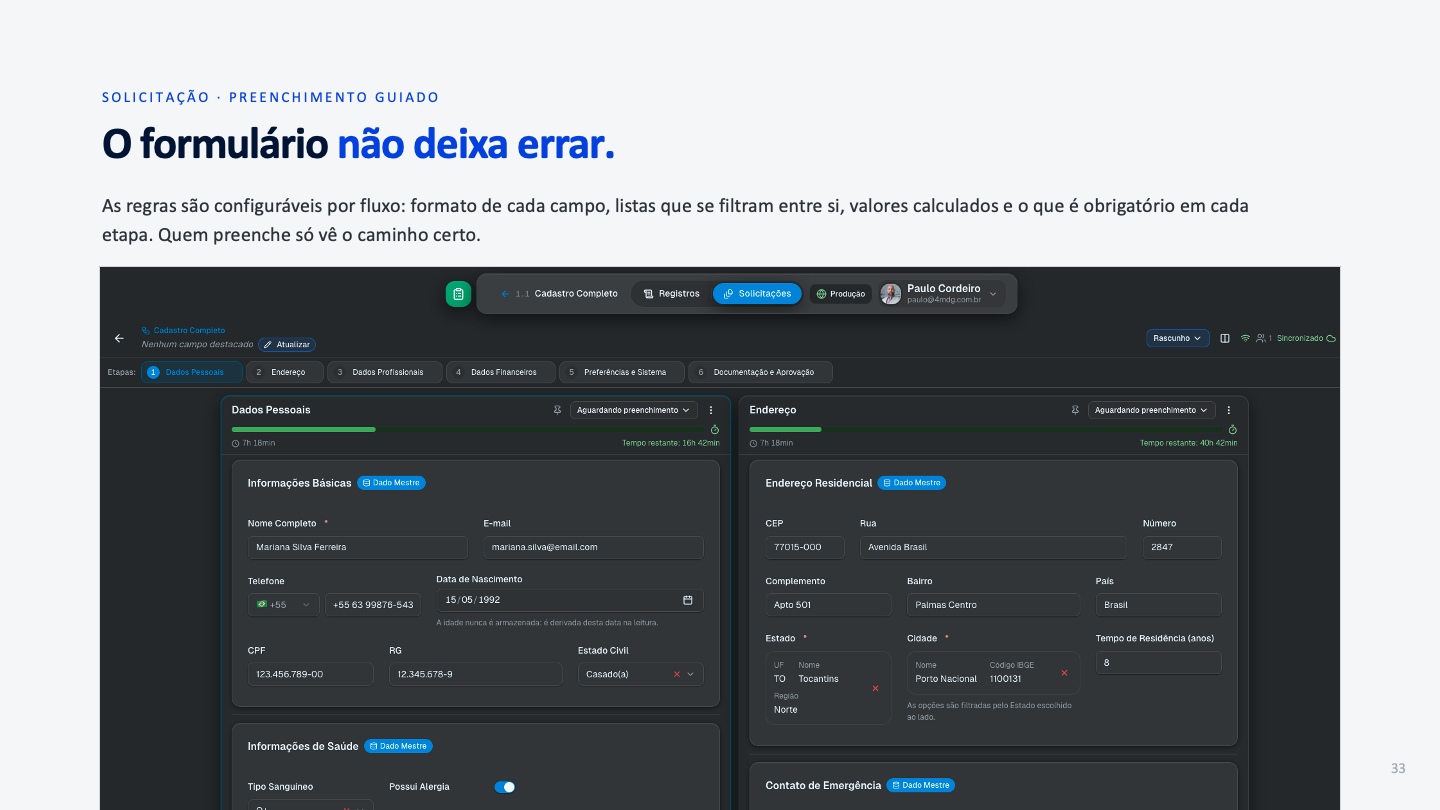
Registration in steps
Named steps, filled side by side, with the time remaining for each and sections marked as Master Data or Process.
02
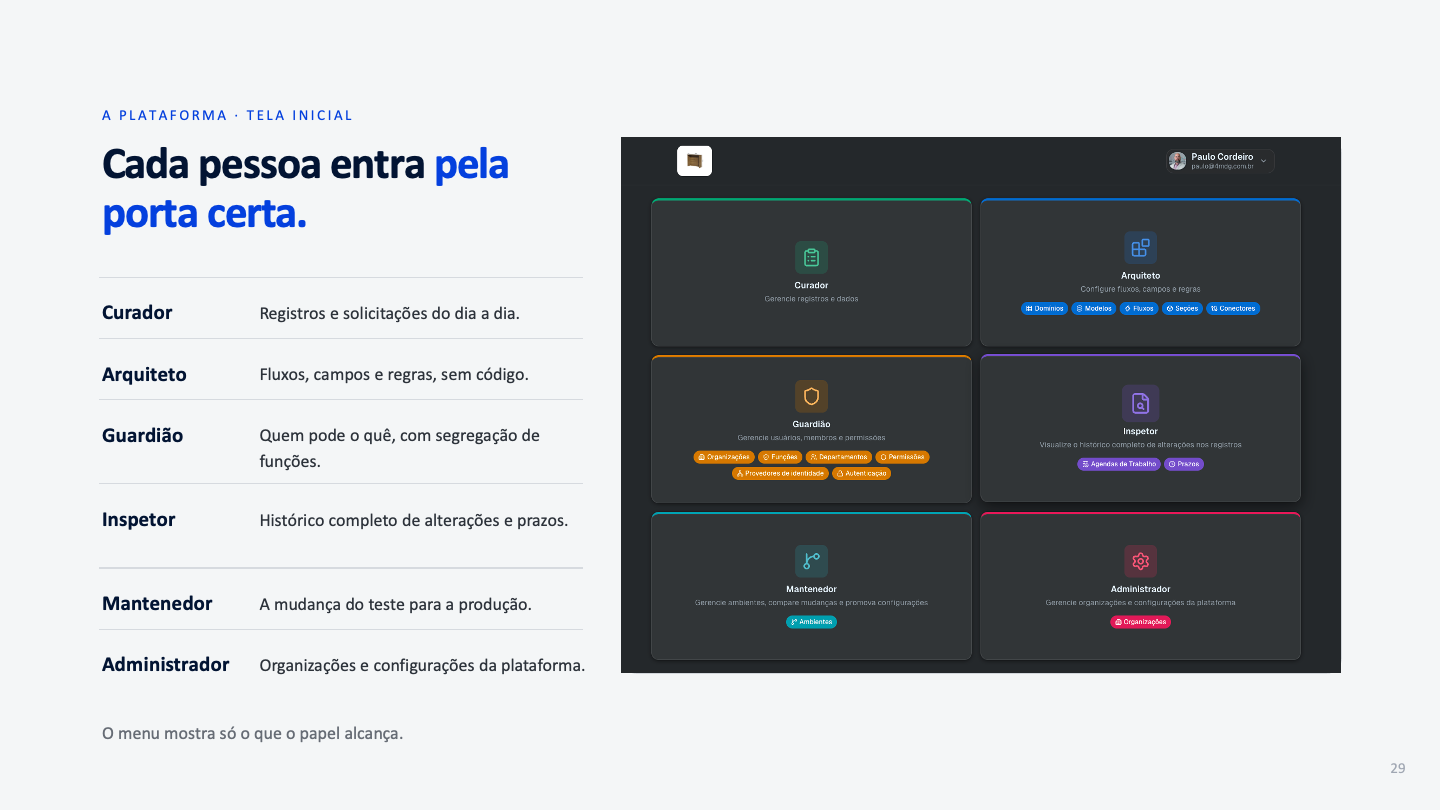
Six roles, six slices
Curator, Architect, Guardian, Inspector, Maintainer and Administrator: each role sees only what it needs to do its part, each with its own ADAM.
03
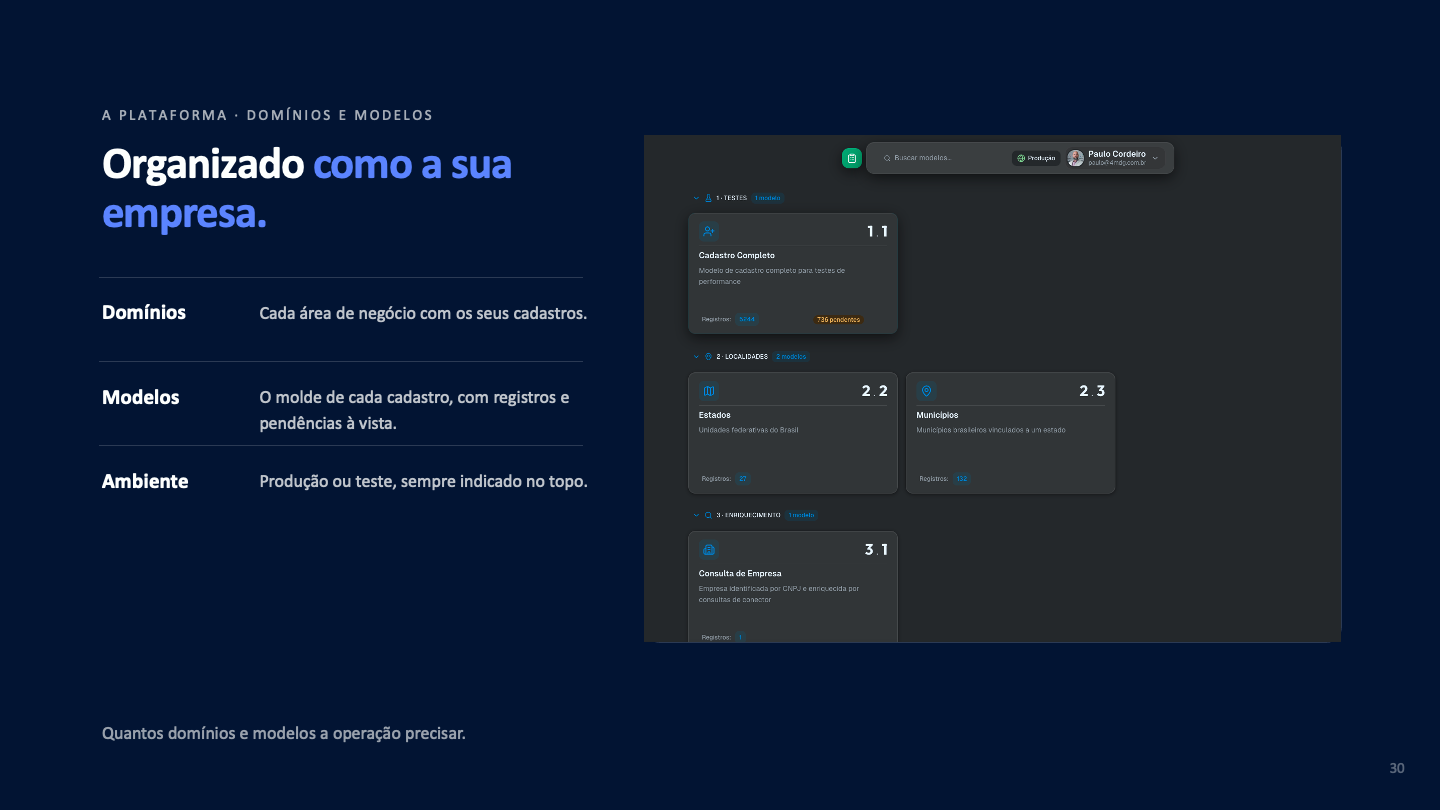
Domains and models
Each business area organized into domains and models, with records and pending items in view, and the environment in use always shown at the top when it is not production.
04
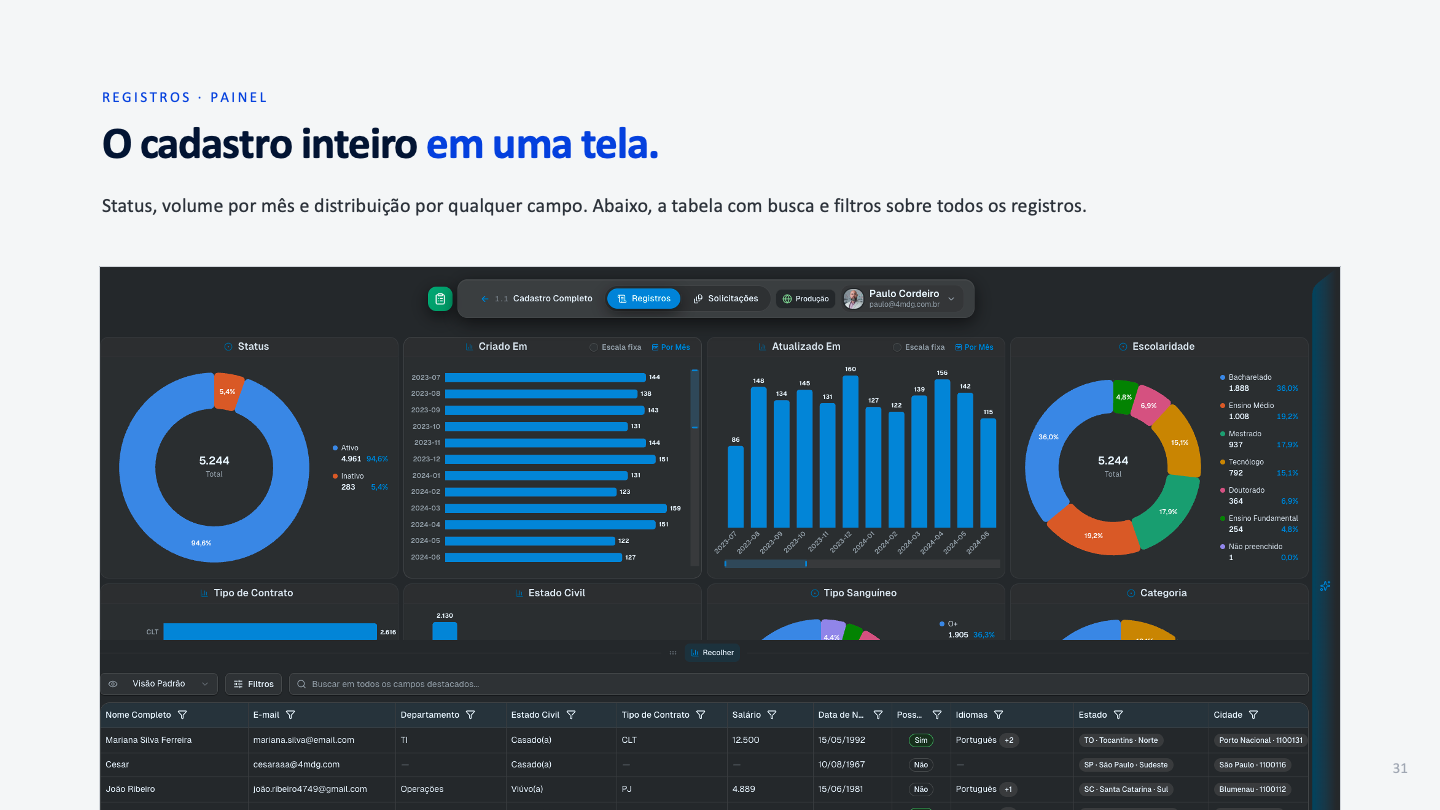
Report
Configurable charts per model and a record table with search and filters, without leaving the platform.
05
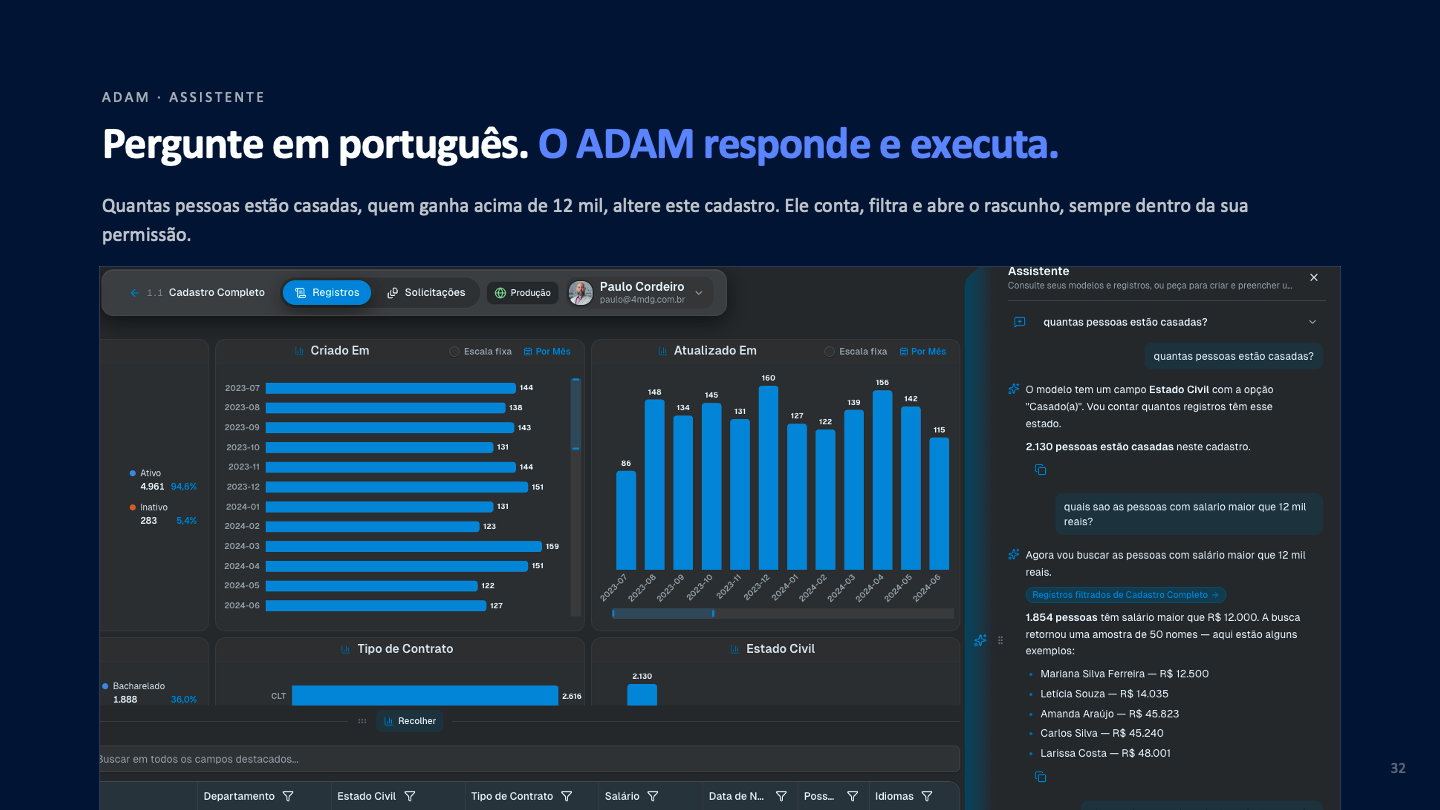
ADAM answers and proposes
Ask your own database in plain language ("how many people are married?") and request a change: ADAM prepares the draft, and anything irreversible only happens when you confirm.
ADAM · AI in every module
AI in every module, with the decision always human.
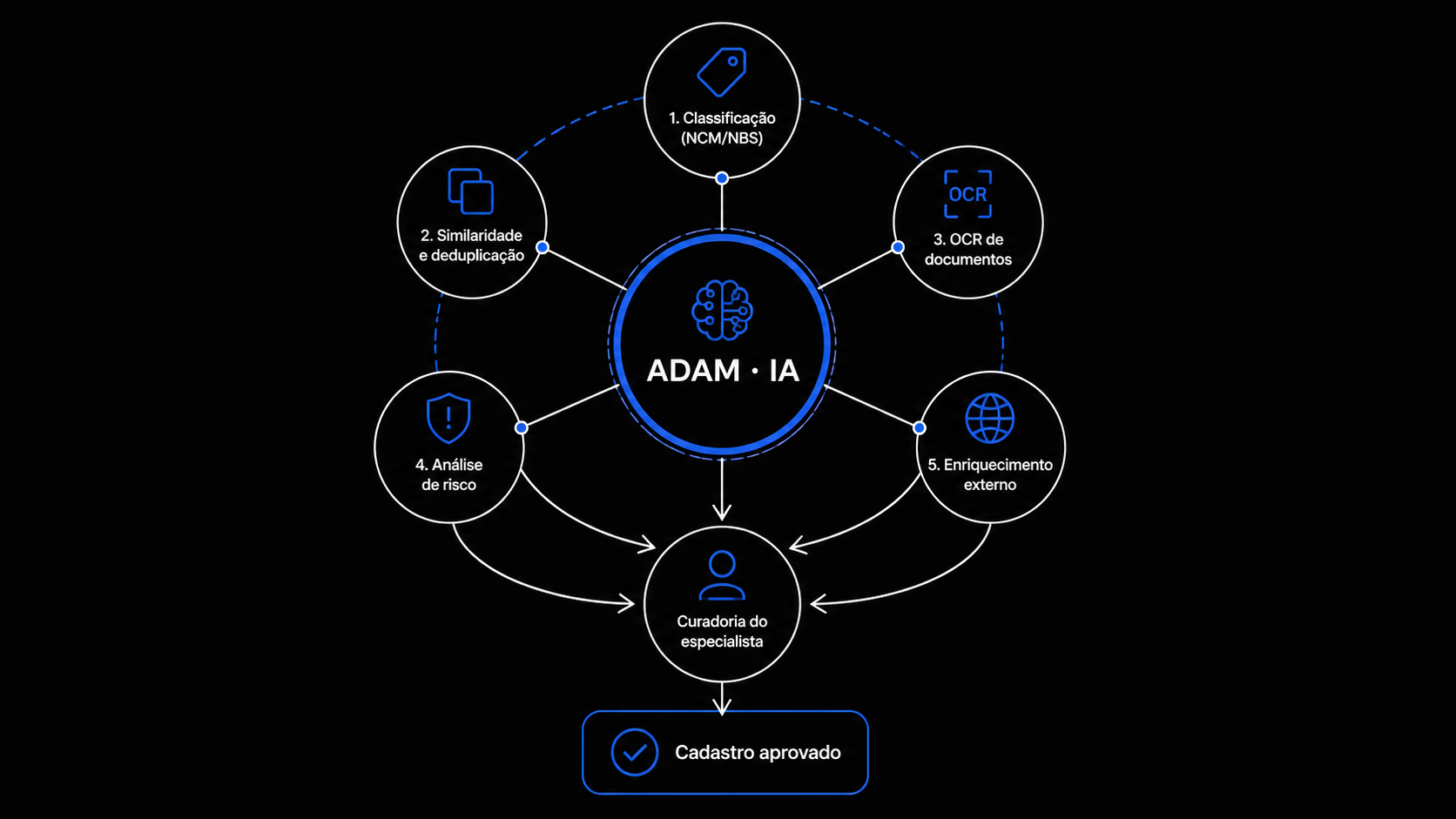
ADAM is the platform's AI assistant: one per module, always with the permissions of whoever asks. It proposes, you decide, and everything it does is recorded as done by you.
One assistant per module
Curator, Architect, Guardian, Inspector, Maintainer and Administrator each have their own ADAM, with the tools for that job.
Query your data in plain language
Queries and aggregations over your own records, respecting the permissions of whoever asks.
Assisted registration
ADAM opens the draft, fills in fields and suggests values. Each suggestion states whether it was observed in a source, derived or unknown, with the evidence, and only becomes a value when a person accepts it.
Configuration by conversation
The Architect's ADAM designs models, flows and rules and tests those rules against real records; the Guardian's manages access; the Maintainer's compares and promotes environments.
System-driven selection
Via API, the AI chooses among candidates the record matching a description, used to match items to the standardized materials catalog.
Explainability, audit trail and spending cap
Each suggestion records its origin, evidence and who produced it. Everything the AI does stays in the history as done by the person, and irreversible actions require explicit confirmation. Each organization chooses its language model from a curated catalog and sets a monthly spending cap.
Documentation and comparison
Docs and comparisongenerated from your live setup.
Every workflow and every model has its own documentation, always up to date because it comes from the living configuration of your environment, not from a separate manual.
Living documentation
Every workflow and every model has a documentation page generated from the current configuration, ready to print or save as PDF.
Comparison between environments
What was created, changed or is in conflict between a test environment and production, before promoting.
Promotion with segregation of duties
Whoever created the changes does not promote them alone.
ADAM explains the workflow
Ask the assistant how a workflow works, which fields a step depends on or what a rule does.
Architecture
A platform that handles the load of both peak and ordinary days.
Separate layers and asynchronous processing for heavy workloads, with per-organization isolation enforced at the database level. Open each block for the components.
A Cloudflare fica na frente da interface, entregando-a a partir do ponto de presença mais próximo do usuário, com entrega global e cache de conteúdo estático para baixa latência.
Certificado digital emitido por autoridade certificadora válida; apenas TLS 1.2 ou superior é aceito, na própria borda da Cloudflare.
Backend em containers Docker orquestrados por Kubernetes.
PostgreSQL gerenciado no mesmo cluster e região da aplicação, sem administração própria.
Busca de texto completo (BM25) dentro do próprio PostgreSQL, sem índice separado para sincronizar.
Arquivos em armazenamento de objetos.
Kubernetes orquestra os containers do backend, com processos separados para a interação do usuário e para o trabalho pesado.
Filas nativas no PostgreSQL mantêm cargas em massa e integrações fora do caminho do usuário.
Isolation by organization imposto no banco: os dados operacionais de cada cliente vivem numa partição própria, e uma consulta sem escopo definido não devolve nenhuma linha.
Deploy contínuo sem interrupção: troca gradual de instâncias, conexões drenadas, e deploy só por pipeline de integração contínua, com validação obrigatória.
Ambientes de teste criados a partir de produção quando você precisar, sincronizados, comparados e promovidos com revisão; o ambiente em uso aparece no topo.
Tenant próprio por cliente, em subdomínio dedicado, com marca configurável (cor, fundo, logotipo e título).
Stack
Integration
Integration ready from the first workflow.
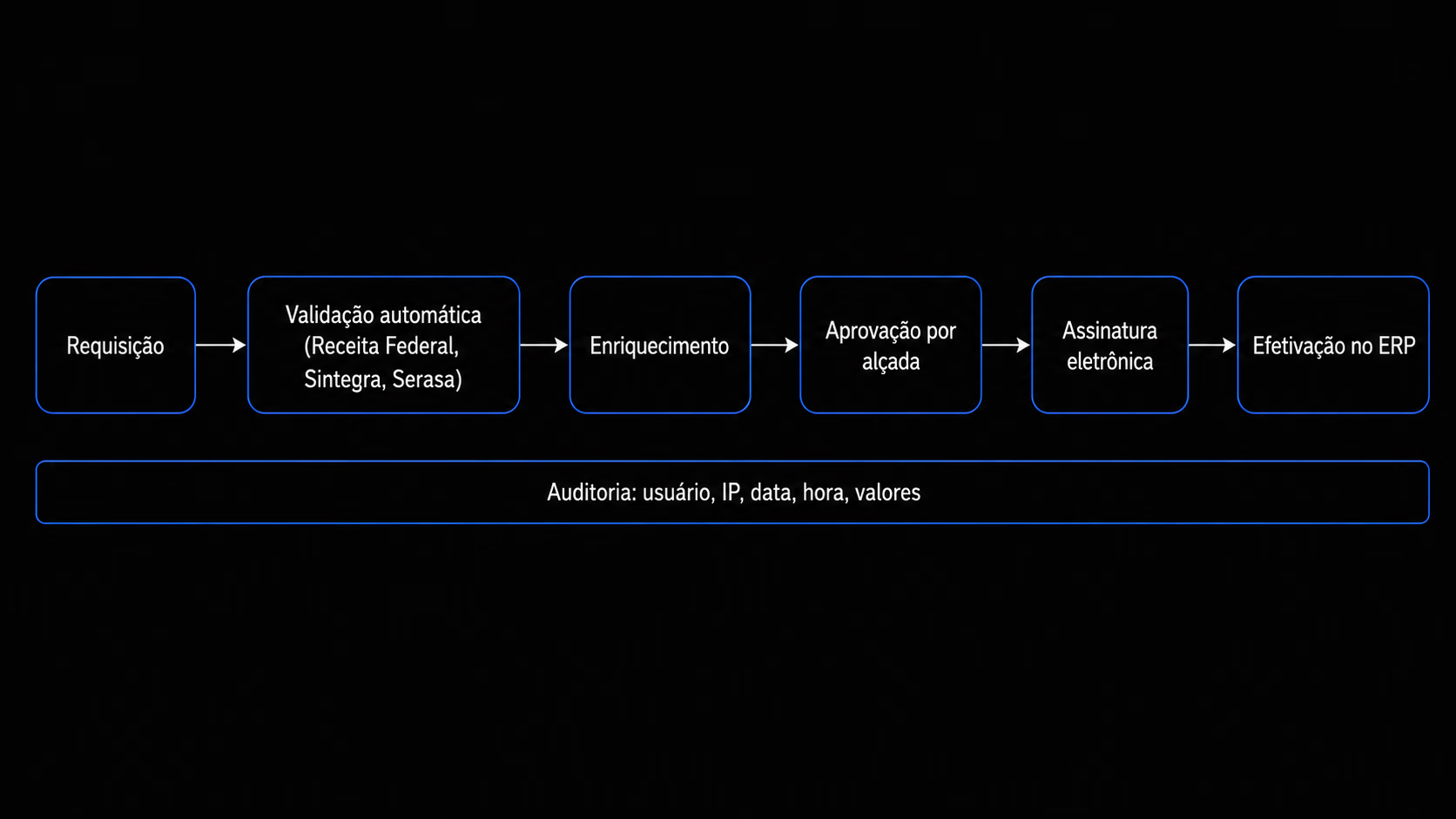
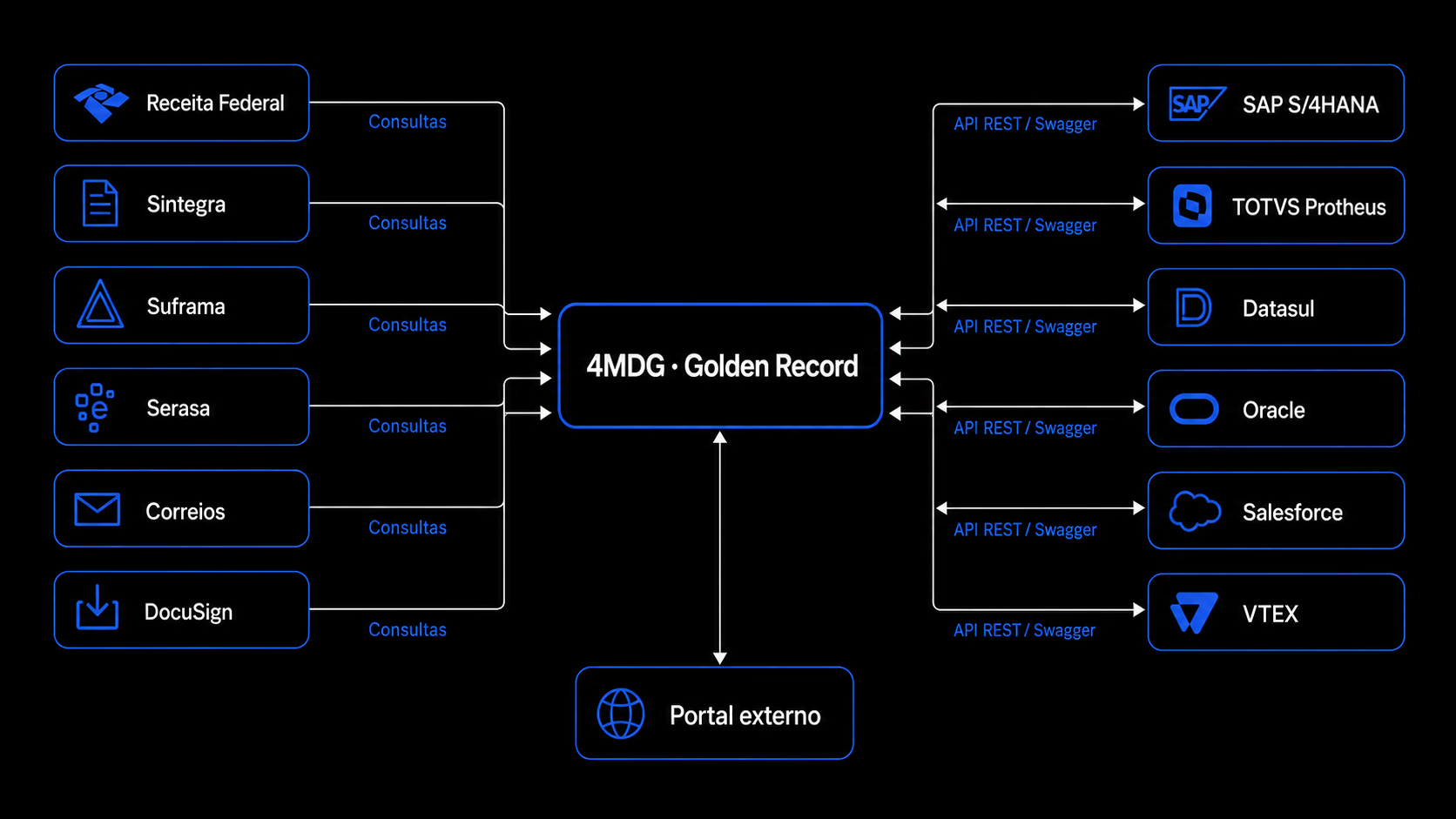
An OpenAPI-documented REST API, an MCP server and connectors we maintain connect the platform to your ERP from the first published workflow.
Public REST API
Documented in OpenAPI, with an interactive reference in five languages; GET, POST, PUT and DELETE. OAuth 2.0 authentication with dedicated service accounts, one per environment, revocable at any time.
Intake and query
An endpoint to open records in any workflow and an endpoint to read records from any model.
Connectors
Every call the platform makes to a connector is cryptographically signed (Ed25519); open SDK and template to build your own connector. The 4MDG connector brings enrichment automations based on public registry databases (Receita Federal, Simples Nacional, Sintegra).
Model 1
ERP response
Each submission records status, attempts, the ERP identifier and the return message, all visible in the record itself.
Model 2
4MDG → ERP
The platform sends data to the ERP through a connector. The flow originates in 4MDG and is directed to the ERP and legacy systems.
Systems and protocols
Security and compliance
Master data is sensitive data.We treat it that way.
Control at the edge, control in the session, control in the record. And documented proof of everything that happened.
ISO 27001
Certified information security management system, with third-party audited controls and periodic review.
LGPD and GDPR
Compliance with the LGPD and GDPR in the handling of personal data.
Encryption in transit
All access over HTTPS, with TLS 1.2 or higher at the Cloudflare edge, and a digital certificate issued by a valid certificate authority.
Authentication and SSO
Corporate SSO per organization, via SAML 2.0 or OpenID Connect, with identity provider groups becoming departments. Also available: login with Google, Microsoft, passkeys, and a mandatory second factor for password login, with automatic provisioning via SCIM 2.0.
Granular access control
Roles per module; permissions by department, flow, and stage (view, edit, approve, advance, publish); section-level visibility; row-level rules.
Complete history per record
Every change records who made it, when, through which channel (screen, API, assistant, MCP, bulk load), and the values changed, with comparable versions in the record itself.
AI under control
AI acts with your permissions, irreversible actions require confirmation, and everything it does is kept in the history.
Continuity
Security and recovery procedures supported by managed cloud services.
Data and analytics
Your data, in your BI, with controlled access.
The same base that powers the platform also feeds your analytics, with no separate index to keep in sync. Authorized users build searches, dashboards and reports on their own records, within the same permissions and the same audit trail as the master data.
Configurable charts. Per model (donut, bar, column, line; count, sum, average, minimum and maximum), clickable to filter the table.
Ask and get answers instantly. Ask ADAM or your own AI via MCP and get the aggregation right away.
Into your corporate BI. Records flow out through the REST API into your corporate BI.
Contact
Talk to our technical team about your master data architecture.
We review integrations, security requirements and your environment's architecture with you. No commitment.
Av. Queiroz Filho, 1700, Tower E, Suites 715 to 718
Vila Leopoldina, São Paulo, SP, 05319-000
Oracle Cloud Infrastructure (OCI), São Paulo region, Cloud SaaS, with a tenant and subdomain per client. Cloudflare delivers the interface globally; processing runs in containers orchestrated by Kubernetes, with managed PostgreSQL.
No. 100% web. To use it through your AI, just add the MCP server in Claude, Cursor or another compatible client.
REST API documented in OpenAPI, with OAuth 2.0 authentication via service account. There are two models: the ERP consumes the 4MDG API, or the platform sends data to the ERP through a connector. Each submission records status, attempts and response in the record itself.
Corporate SSO per organization, via SAML 2.0 or OpenID Connect, with the identity provider your company already uses. Also available: login with Google, Microsoft, passkeys, and email and password with mandatory second factor. Provisioning can be automatic, via SCIM 2.0: your company directory creates, updates and deactivates users in 4MDG, and anyone removed from the directory loses access at the same moment. Integrations use their own service accounts, with permissions revocable at any time. MCP uses OAuth, authorized by the person themselves.
TLS 1.2 or higher at the Cloudflare edge, a digital certificate from a valid certificate authority, access control by department, flow and step, and access to production only through the continuous integration pipeline.
Yes. We maintain ISO 27001 certification and adopt security practices compatible with LGPD and GDPR, including encryption, authentication and a full history per record.
Yes. Every change records who, when, through which channel and what changed, with a history and versions panel in the record itself.
Test environments created from production whenever you need, synchronized, compared and promoted with review; the environment in use appears at the top when it is not production.
Yes. The database itself powers free search and configurable charts, with no separate index to keep in sync, and records can be sent through the REST API to your corporate BI.
You do. Access to the administrative portal is included in the subscription, allowing you to create new flows, screens, fields and rules without depending on us, with support from our team when needed, including by talking to the Architect's ADAM.
Não. A IA sempre atua com as permissões da pessoa que pergunta ou que autorizou a conexão, seja pelo assistente interno, seja pelo MCP.
Sim, pelo servidor MCP nativo da plataforma. A conexão é autorizada por OAuth pela própria pessoa.
Não. Atos irreversíveis, como publicar um cadastro, promover um ambiente ou remover acessos, exigem confirmação humana, dentro da plataforma.
A organização escolhe o modelo de linguagem de um catálogo curado e define um teto de gasto mensal.