
Each material with a single name. At last.
Descriptive material standardization, also known as the Descriptive Material Standard (PDM) or material cataloging, is the process of describing each item in a unique, structured and standardized way, with a clear taxonomy of characteristics. We standardize and enrich your material records on an MDM (Master Data Management) platform, with automation and AI, eliminating duplicates and confusing descriptions that hold back purchasing, inventory and production.
160 clients trust us












Prepare your master data for the Brazilian Tax Reform

Pain
"Screw", "scr." and "SCREW M6" are the same item. And the system doesn't know it.
Free-form, non-standardized descriptions create duplicate items, repeat purchases, idle stock and reports no one trusts. The larger the base, the greater the chaos. And the stockroom clerk ends up deciding by eye: registering the item again, because searching takes more work than creating.
Duplicate items that turn into repeat purchases
Idle stock that no one can find
Wrong product classification that turns into tax risk
How we solve it
Taxonomy, standards and automation, at scale.
Each family gets a template of mandatory and optional attributes, so no one registers items through a free-text field anymore.
The standard comes from your business, not from a generic catalog imported from outside.
Anyone searching finds the item by attribute, not by luck in writing the description the same way a colleague did.
The short description respects the ERP character limit; the long one carries the full technical detail.
Abbreviations, units and attribute order follow a single rule, regardless of who typed them in.
Procurement negotiates better because the item is described the way the supplier understands it.
The engine compares attributes, not just text, so "hex bolt m6" and "BOLT M6" fall into the same group.
Every merge goes through a specialist, with the history logged for auditing.
The base stops growing artificially, and the capital tied up in duplicate items returns to the operation.
See the Quality & Data Cleansing capability on the platform →A well-described item is a well-classified item: product and service tax codes stop being guesswork.
In Brazil's Tax Reform, correct classification defines the rate, the regime and the credit you can recover.
Fewer disallowed credits, fewer assessments and less rework in every filing.
The approved item enters SAP and the other systems clean, with no re-typing.
We also integrate with Oracle, TOTVS, Senior, Mega and the main ERPs on the market.
In a rollout or migration, standardization happens before the load: the new system starts clean.

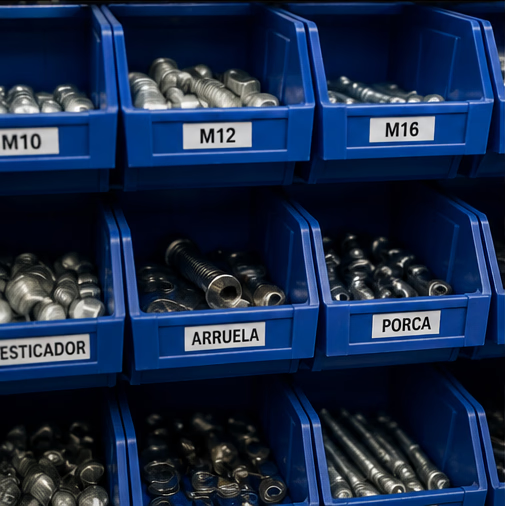
In the warehouse, everyone labels. In the master data, almost no one does.
Want to know how many duplicate items exist in your catalog today? The free assessment measures it in just a few days.
Get the free assessmentPDM is the rule; material master data cleansing is the project that applies the rule to the existing catalog.
Material master data cleansing →Classification and additional data
A standardized description is the start. The complete record is the goal.
Along with the description, we deliver material coding and material classification in the standards your operation uses, plus the data that procurement, tax, logistics and quality need to find in the record.
International standard
What UNSPSC is, and why we standardize on it
UNSPSC (United Nations Standard Products and Services Code) is an international standard for classifying products and services, maintained by GS1 US under the endorsement of the United Nations. It organizes the item into a hierarchy of segment, family, class and commodity, with a unique code for each level.
With the catalog classified in UNSPSC, spend by category becomes comparable across plants, companies and countries, procurement can consolidate demand and negotiate by family, and the data speaks to sourcing systems and marketplaces that already use this standard. We classify the item in UNSPSC together with the descriptive product standardization, in the same standardization flow.
Additional data
What else goes into the record
Translation into English and Spanish, for multi-country operations and catalog sharing across units.
Unit of measure normalized, with a conversion factor between purchasing, inventory and consumption units.
Packaging attributes: type, quantity per package, purchase multiple, weight and dimensions.
ANVISA regulatory attributes, when applicable: registration or notification, holder, presentation and risk class.
UNSPSC classification and descriptive product standardization, along with building the description, are supported by ADAM, our machine learning, with human validation before publishing to the ERP.
Learn about ADAM
Artificial intelligence
ADAM standardizes materials and sustains governance afterward.
ADAM is 4MDG's artificial intelligence. It reads the free-text description that comes from the requester, understands which material it refers to, proposes the standardized description, fills in the missing characteristics and points to the record that already exists in the base before a new one is created.
Cleansing
Legacy base in order
In the initial load, ADAM classifies and rewrites thousands of items at once, flags duplicates for review and returns the base with a single standard.
New record
Standard from the start
With each new request, the suggestion is already on screen: description, class, characteristics, classification and UNSPSC. The analyst reviews instead of typing from scratch.
Governance
A standard that doesn't degrade
The model keeps running on the production base, flagging standard deviations, new duplicates and incomplete fields for the steward to handle.
The final decision is always human: ADAM suggests and your team approves, with an audit trail of who accepted or rejected each suggestion.
Results
A clean catalog pays for itself.
The cost of bad data does not show up as a budget line. It shows up spread across repeat purchases, idle stock, disallowed credits and wrong decisions. The market has already measured this bill.
US$ 12,9 mi
is the average annual cost of poor data quality for an organization.
Source: Gartner, data quality survey
15 to 25%
of annual revenue is what companies lose because of bad data.
Source: MIT Sloan Management Review with Cork University Business School
59%
of organizations do not measure the quality of their own data, so they operate without knowing the size of the loss.
Source: Gartner, surveys with organizations
60 mi
records already managed
by 4MDG
321+
MDM projects
delivered since 2019
We know the size of this bill because we have faced it at industrial scale, with real clients and real databases.
Explore our Data Cleansing service →Step by step
How to standardize a catalog in five steps.
01
Diagnosis
We measure duplicates, empty fields and conflicting standards in your current base.
02
Taxonomy
We define families and attributes with procurement, inventory, tax and production.
03
Standardization
We rewrite short and long descriptions to the standard, with automation and AI.
04
Deduplication
We group and merge identical items, with specialist approval.
05
Governance
Workflow and rules keep the standard alive, so the base stays clean.
We integrate with what you use
Contact
Request the free assessment of your catalog.
We show you how many duplicate items, non-standard descriptions and inconsistent tax classifications exist in your database today. No commitment.
Av. Queiroz Filho, 1700, Torre E, Conjuntos 715 a 718
Vila Leopoldina, São Paulo, SP, 05319-000
Describing each material in a unique, structured way, with a standardized taxonomy of characteristics, avoiding duplicates and inconsistencies.
Unstandardized descriptions create duplicates, repeat purchases, idle inventory and unreliable reports. They also compromise the item's tax classification.
We define the taxonomy, standardize descriptions, deduplicate and enrich the data, and integrate it into the SAP material master, so the item enters already clean.
Yes, to speed up duplicate identification and standardization at scale, always with human governance on approval.
Everything. NCM, NBS and service codes are assigned based on the item description. A poorly described item is a poorly classified item, and the wrong classification sets an undue rate and regime, turning into disallowed IBS and CBS credits, tax assessments and rework at every filing.
It depends on the volume and the number of families. We work in waves, starting with the families with the greatest impact on purchasing and inventory, with visible results from the first weeks instead of waiting for the entire catalog to be finished.
No. PDM is the rule; material master data cleansing is the project that applies the rule to the existing catalog. The Descriptive Material Standard defines the family, the attributes and the format of the description. Data cleansing uses that standard to review the items that already exist, merge the duplicates and classify each material.
None: it is the same concept with two names. Descriptive Material Standard is the classic name, and descriptive material standardization describes the process. Both are called PDM, and also material cataloging.