
Customer and vendor data cleansing
Customer and vendor data cleansing: CPF and CNPJ validated, duplicates merged, records ready to invoice and pay.
Customer and vendor data cleansing, also called customer and supplier master data cleanup, record updating, bulk CNPJ and CPF validation or data enrichment, is the review of every customer and every supplier to validate CPF and CNPJ against official sources, correct address and state registration, merge duplicates into a golden record and complete the master data, before loading the result into the ERP.
Within a few days you see how many customers and suppliers are duplicated, have an irregular CNPJ or carry outdated data. No commitment required.
Trusted by 160 clients











What we validate
What is validated for each customer and supplier.
CPF and CNPJ with the Receita Federal
Existence, registration status and official data checked at the source, with evidence stored for each record.
State registration
State registration, Sintegra and Suframa checked, to issue and receive invoices without rejection.
Address and postal code
Normalized address and checked postal code (CEP), the same on the invoice, the order and the delivery.
Certificates
Federal, state and municipal certificates and CNDT checked, with expiry tracking.
Sanctions lists
Sanctions and restricted lists checked to meet compliance policy and the LGPD.
Bank details
Bank details validated together with the supplier's CNPJ, before the first payment.
Ownership structure
Partners and ownership structure checked, so you know who your company is really doing business with.
Tax regime
Simples Nacional and tax regime checked, because they also define tax and credit.
Golden record
Deduplication into a golden record: one customer, one record.
Cleansing
One format, field by field
Corrects and standardizes legal name, trade name, address, contacts and mandatory fields that are out of standard, with the same format across the whole customer and supplier master.
Customer onboarding →Deduplication
One customer, one record
Finds customers and suppliers repeated by CPF, CNPJ and similarity, and merges each group into a golden record, with headquarters, branches and corporate group linked.
Supplier qualification →Enrichment
Official data, checked at the source
Completes the record with tax status, CNAE, address and certificates, checked across more than 600 public sources, with evidence stored for each record.
See the data sources →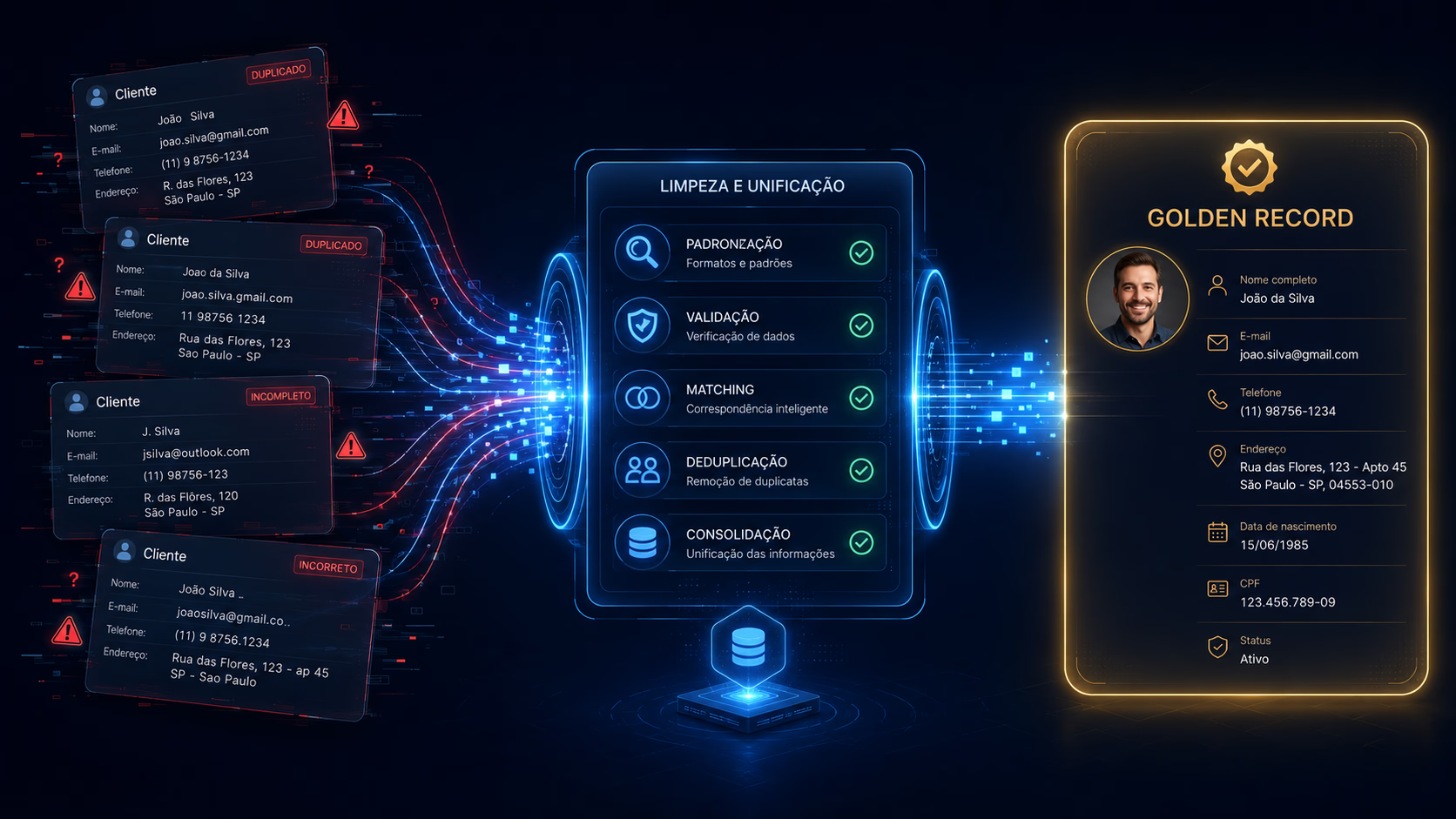
Cleansing, deduplication and enrichment happen in the same flow.
Tax Reform
Data cleansing before Brazil's Tax Reform: IBS and CBS credit depends on the master data.
Under the dual VAT model, the tax your company pays and the credit it takes now depend directly on the quality of the customer and supplier master data.
Buying
Supplier record
It is the supplier that generates the IBS and CBS credit your company takes. An irregular CNPJ, a suspended state registration or an outdated tax regime puts that credit at risk.
Supplier qualification →Sales
Customer record
A customer with the right tax regime, CNAE, registration and address is what supports the IBS and CBS calculation and the credit on the transaction.
Customer onboarding →Periodic revalidation
Tax regime and registration change, and the record is revalidated against official sources, because they also define tax and credit.
Due diligence before purchasing
Partners, tax history and restrictions checked before the purchase happens, not after the invoice is rejected.
Invoices without rejection
State registration, Sintegra, Suframa and tax regime checked so the invoice goes through on the first attempt.
The diagnostic shows how many suppliers have irregular records today.
LGPD
LGPD and personal data minimization.
The customer and supplier master holds personal data: the CPF of individuals, the names and contacts of representatives, the partners. Data cleansing processes this data for a defined purpose and checks only what the master data needs to invoice, pay and meet tax obligations.
Every lookup is logged, with evidence for each record, and access to the master data follows the profile of whoever operates it.
Your master data is processed under an ISO/IEC 27001 certified management system and in compliance with Brazil's LGPD.
We show what data cleansing checks, field by field, before we start.
In SAP
Customer and vendor data cleansing in SAP.
Business partner (BP)
In SAP S/4HANA, customers and suppliers live in the business partner, and data cleansing validates CPF and CNPJ and merges duplicates before loading.
Headquarters, branches and corporate group
Headquarters, branches and corporate group are linked in the master data, with the single customer view that sales and credit need.
Loading by IDoc, BAPI and file
The cleansed data enters SAP ECC or S/4HANA through API, IDoc, BAPI or file, day to day and in projects.
Rollout and migration to S/4HANA
In a rollout or migration, customers and suppliers are cleansed before loading: the business partner starts without duplicates.
Governance after go-live
Entry rules, automatic CNPJ validation and an approval workflow keep the master data clean after loading.
Method
How to cleanse customer and vendor data in five steps.
STEP 01
Diagnostic
We measure the state of the data: duplicates, invalid CPF and CNPJ, irregular registration status and empty critical fields.
STEP 02
Standardization
We standardize legal name, address, contacts and mandatory fields by rule, with the same format across the whole master data.
STEP 03
Deduplication
We merge repeated customers and suppliers into a golden record, with similarity scoring and survivorship.
STEP 04
Validation and enrichment
We check CPF, CNPJ, state registration, certificates and tax regime across more than 600 public sources, with the help of AI.
STEP 05
Continuous governance
We set up automatic validation at entry, an approval workflow and periodic revalidation, so irregular records do not come back.
The fifth step is what keeps the data clean after the project.
Your data is not clean just once: it stays clean.
The diagnostic shows where to start in your customer and supplier data.

Results
Clean master data, measured results.
−87%
Wella Company · supplier master data SLA, with −78% for customers and 100% of master data managed by 4MDG.
600+
Public sources · checked at the source: Receita Federal, Simples Nacional, Sintegra, Suframa and certificates.
60M
records under management, across 321 projects for 160 clients in 6 countries.
Wella Company cleansed its data and now has 100% of its master data managed by 4MDG, with an 87% lower SLA for suppliers and 78% lower for customers.
In supplier qualification, the record arrives validated for CNPJ, registration status, state registration and tax regime before the first order.
In customer onboarding, CPF and CNPJ are validated at the source, and the data is ready to invoice without rejected invoices.
I want these results in my dataInvestment
How much customer and vendor data cleansing costs.
The price depends on the size and depth of the work, not on a fixed price list. Five factors define the investment.
That is why the first step is to measure: the free diagnostic counts the records, the duplicates and the irregular records in your data before any quote.
Volume and type of record
How many customers and suppliers, individuals and companies.
Depth of validation
CPF and CNPJ only, or also state registration, certificates, sanctions, ownership structure and bank details.
Sources and format
Which external sources are consulted, and whether it is a one-off project or monthly Data as a Service.
The diagnostic measures the data before quoting, with nothing to install.
Contact
Let's look at your data before proposing anything.
A specialist analyzes a sample of your customers and suppliers and shows the current state of your master data. No commitment required.
Av. Queiroz Filho, 1700, Torre E, Conjuntos 715 a 718
Vila Leopoldina, São Paulo, SP, 05319-000
FAQ
Questions about customer and vendor data cleansing
It is the review of every customer and every supplier to validate CPF and CNPJ with the Receita Federal, check registration status, state registration, address and tax regime, merge duplicates into a golden record and complete the master data. The result is data ready to invoice and pay, with no rejected invoices and no payments to the wrong CNPJ.
Yes. CPF and CNPJ are validated in bulk with the Receita Federal, including registration status, and checked across more than 600 public sources: Simples Nacional, Sintegra, Suframa, certificates and restricted lists. Every lookup is logged, with evidence for each record.
For a defined purpose: data cleansing checks and stores only what the master data needs to invoice, pay and meet tax obligations. Every lookup is logged, and the master data is processed under an ISO/IEC 27001 certified management system and in compliance with Brazil's LGPD.
Because it is the supplier that generates the IBS and CBS credit your company takes. A supplier with an irregular CNPJ, a suspended state registration or an outdated tax regime puts that credit at risk. Data cleansing revalidates this data against official sources before the purchase happens.
Yes. In SAP S/4HANA, customers and suppliers live in the business partner, and data cleansing validates CPF and CNPJ and merges duplicates before loading, through API, IDoc, BAPI or file.
It depends on the number of records, whether they are individuals or companies, the depth of validation, the external sources consulted and whether it is a one-off project or monthly Data as a Service. The free diagnostic measures your data before any quote.